Where did the Spargo’s come from?
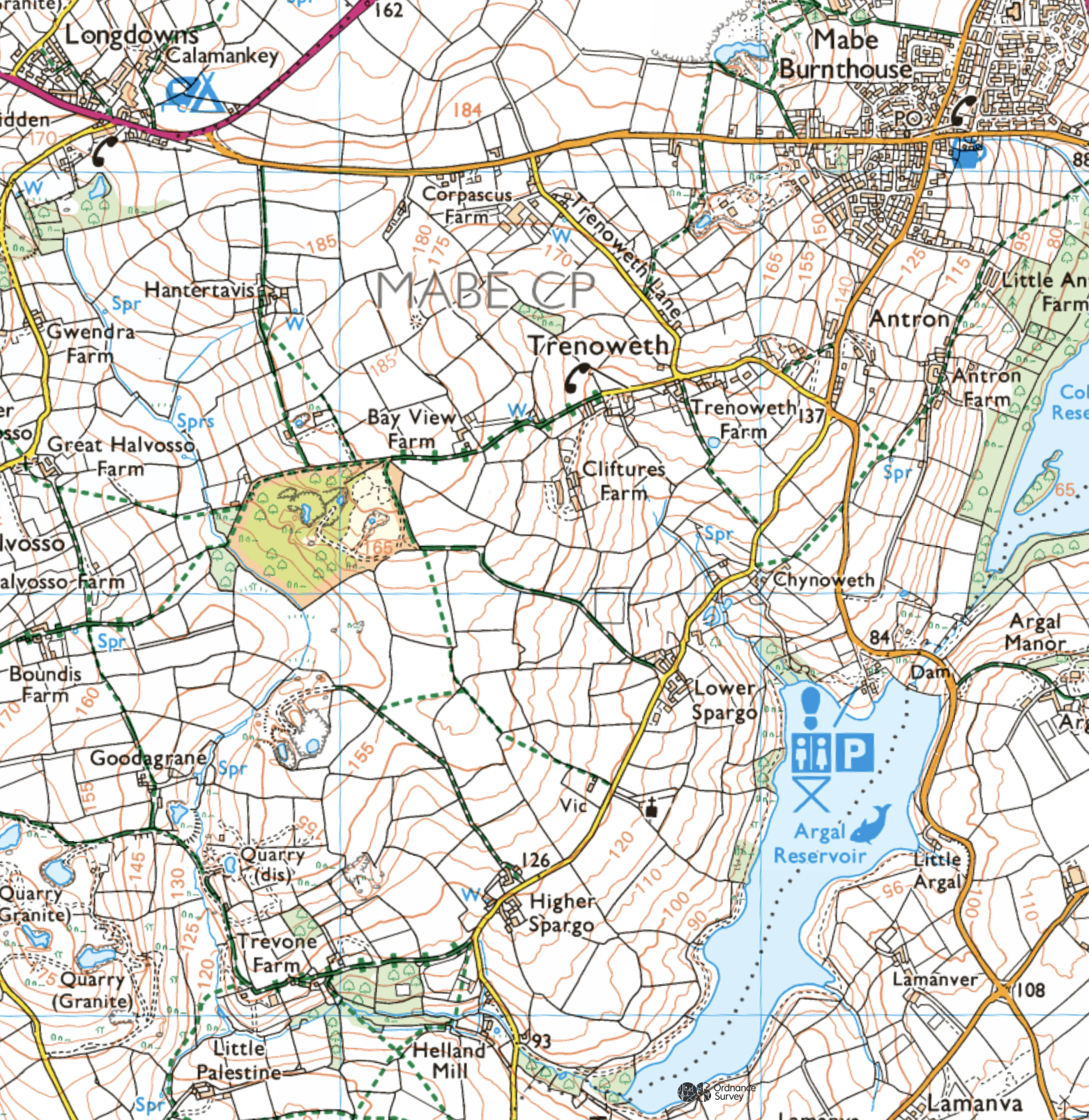
A clue is that there are two place names in the parish of Mabe, Lower and Higher Spargo. The word Spargo is thought to come from the Cornish for thorny place. Family folklore says that we descended from the Phoenicians who came to Cornwall in search of tin. Difficult to prove, but our auburn hair and pale skin does not follow the Celtic look, but equally would those from the Middle East have had fair skin?
If you need any proof as to our origins in Mabe, visit the church which is just outside the village. The churchyard has many gravestones with the Spargo name on them. The name is common in this part of Cornwall.
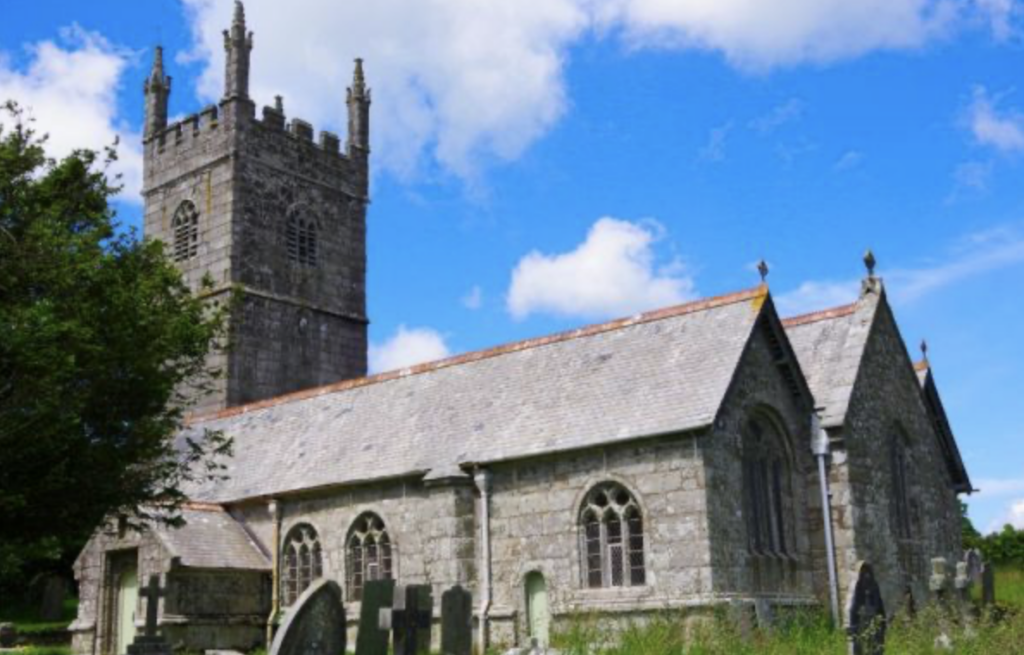
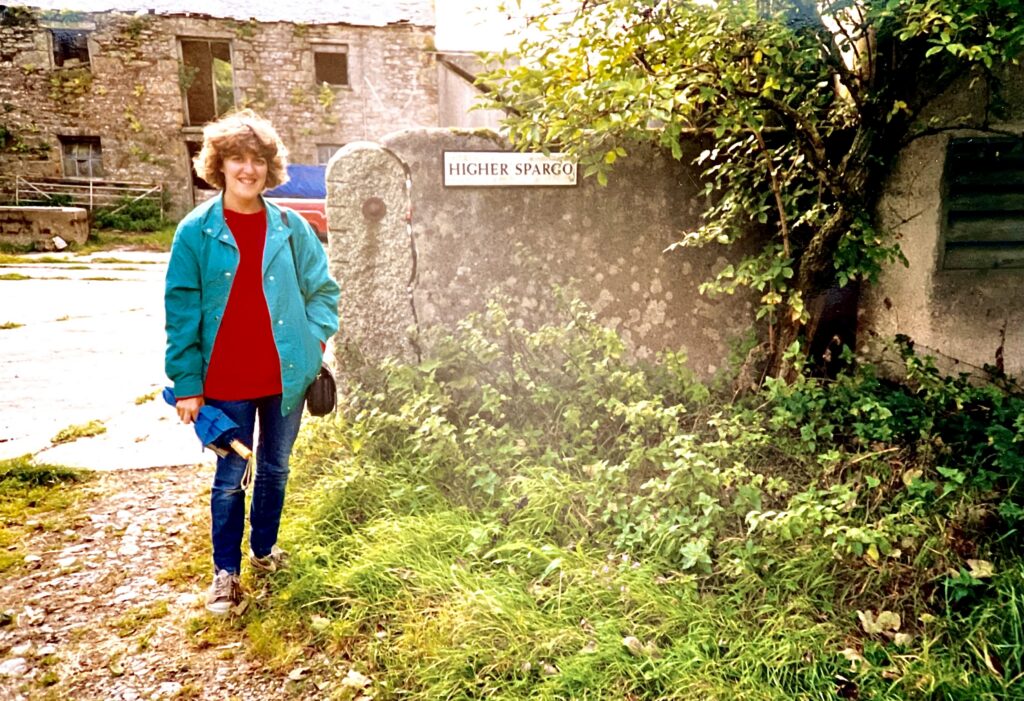
This is just a little further out of the village past the Church
The popularity of the name makes the tracing of the family tree further back than the mid 1750s difficult. A lot of Johns and James’. So I will start with the first Spargo who left a record of his existence , Obed Thomas (Tommy’s) 2 times Great Grandfather James Stephen Spargo (Spargoe).
James Spargoe ( aka Spargo) was born in 1779 in Mabe Cornwall to James and Mary. He was baptised in the neighbouring parish of Mylor on the 14th February 1779 – the entry notes that his residence was Mabe. He married Margaret Collins also known as Peggy on the 2nd October 1803 in Mabe. James signed the register and Margaret made her mark suggesting that she could not write. The transcriber notes that the groom signed his name as Spargoe.
They had eight children, seven who lived beyond the first year. Their fourth child and second son was William Spargo, Tommy’s great grandfather born in 1811. Apart from William, this next generation of men were not long lived. James, the eldest, James, died at 34, John at 58, Hugh at 36. Thomas (his heir) disappears.from the record after 1853. The two girls, Mary and Peggy, may have lived longer lives.
To see the family tree of him and his children click here
In 1813 James was recorded as a Farmer on his son John’s baptism entry. On the 11th March 1828 a lease was signed for the Palestine tenement for 10 years for the consideration of £45 a year. On the same date a lease on 3 lives for Nicolls Down in Palestine was given for the consideration of £10 a year. This kind of lease was where three people could be named, often the main lessee, perhaps the wife and or children and was common in Cornwall at this time. The lessor was Thomas Hext from St Austell. It would seem that the 10 year lease was renewed twice more as in the 1841 and 1851 censuses he is described as a farmer of 80 acres and living on Palestine Farm Mabe.
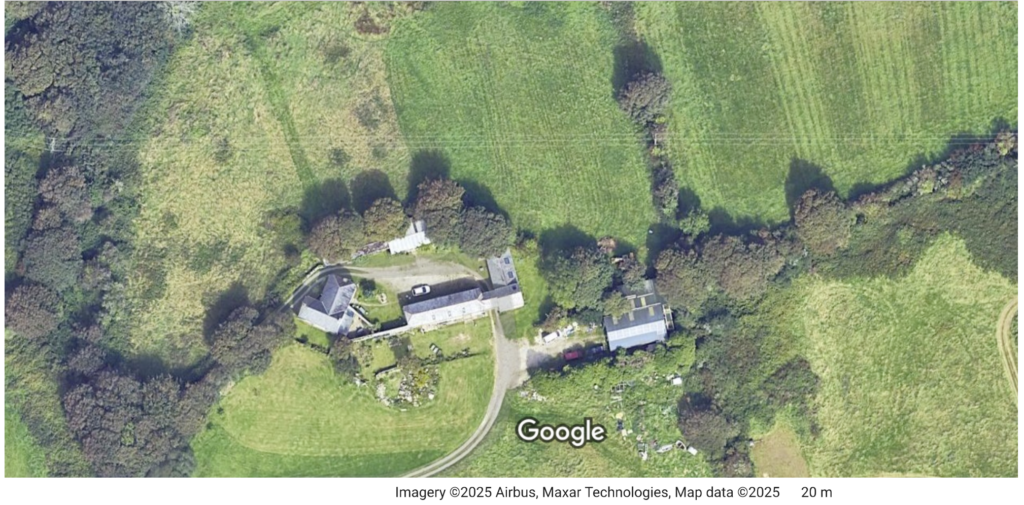
On the voting list of 1834 he is listed as James Stephen Spargoe, Leaseholder of Palestine.
This was probably the first time that he was eligible to vote. Previous to 1832 only landowners and those paying particular taxes could vote. The 1832 First Reform Act broadened the franchise’s property qualification in the counties to include small landowners, tenant farmers and shopkeepers. The rental qualification was £50 a year. The franchise only extended to men, a retrospective step as before the Act under the old rules there were occasions where a woman qualified for the vote.
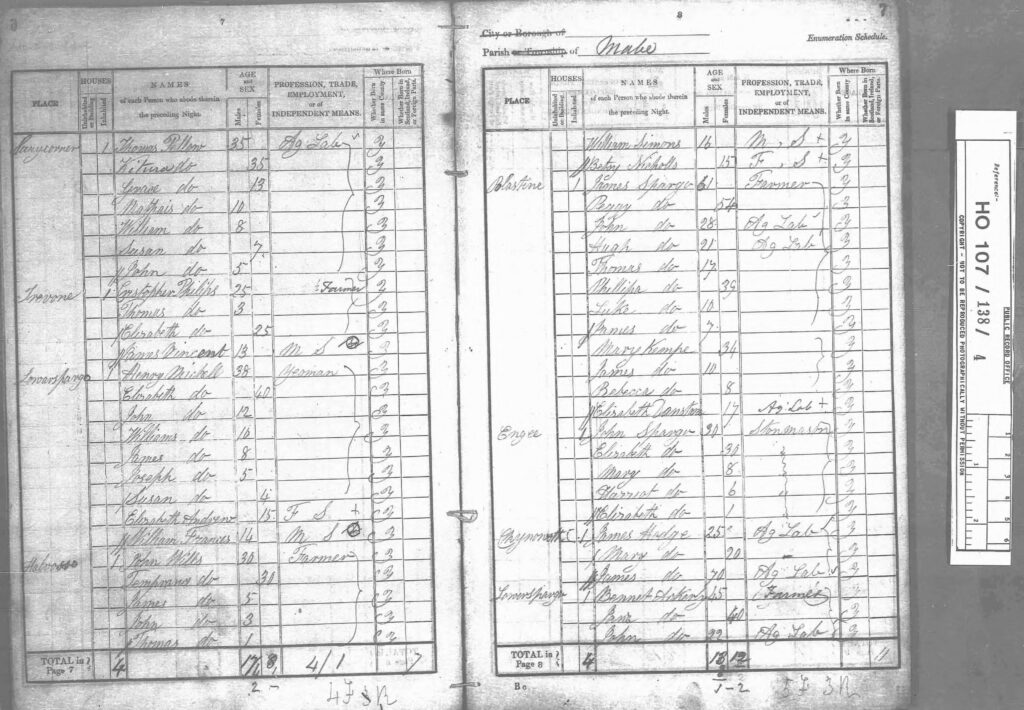
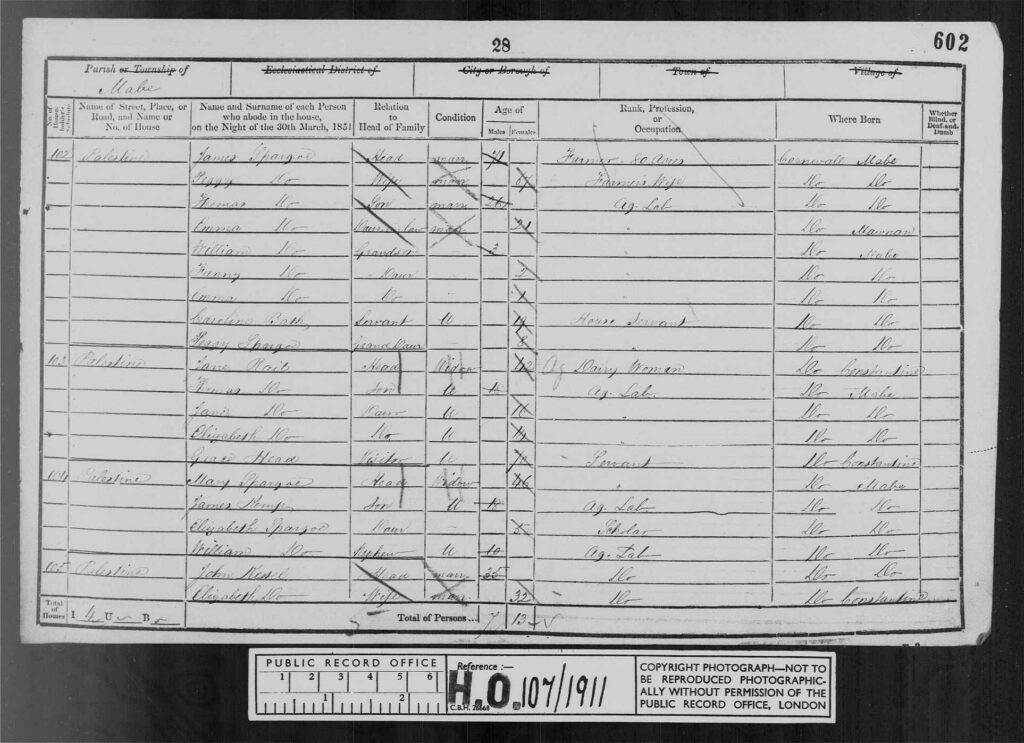
The most interesting document regarding James is his Will which he made in 1851 after the death of his wife Peggy in May of that year. The original is held at Kresen Kernow – the Record Office in Redruth

The Will is probably a transcript of the original. It is likely that there were clerks who were employed to do this sort of work, The witnesses are neighbouring farmers – they appear in the 1851 census. The wording, particularly at the beginning suggests a strong religious leaning and was a typical form for the time. At least some of the family were Methodists. His son’s daughter Peggy was baptised at Penryn Wesleyan Chapel in 1843.
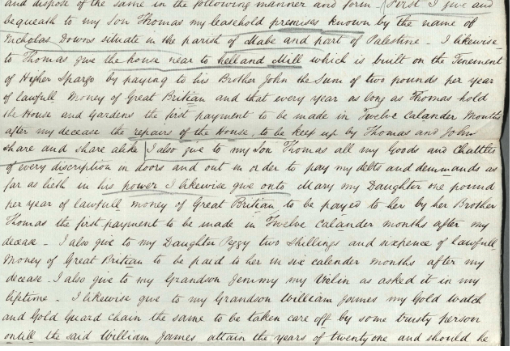
There are bequests to his four surviving children – but nothing for William. Was there a family fall out? William the first generation to engage in the trade of stonemason leaves a quarrying area to move to West Penwith. A mystery. To read more about the history of quarrying in Mabe click here
Of particular interest is the bequest of his violin to his grandson Jemmy (James). This could be the son of his daughter Mary – James Kempe, or James Spargo son of the testator’s late son James. His gold watch was left to grandson William James son of sister Peggy.
And here is Thomas’s signature – he also spells his name Spargoe.
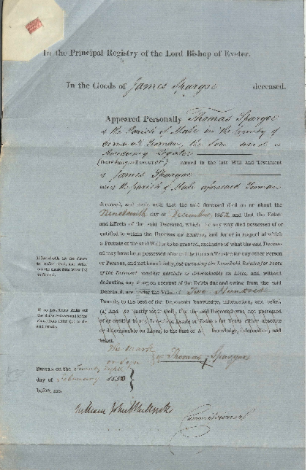
So how much was James Spargoe’s estate worth? It is rated as under £200 for probate. He did not own the land he farmed, but he was clearly an important citizen of the parish and a cultured man.
What were the bequests actually worth?
£2 would be worth approximately £162 in 2017 and would buy you 3 stones (42lbs) of wool but not enough to buy a cow in 1850.
2 shillings and sixpence (12 ½p) would be worth about £10. So a shilling……. Not much. Suggests that James did not have a lot of cash, or it was left to Thomas to run the farm.
To see the complete Will and a transcript, click here
James’s daughter Mary Anne was born in 1808. She had a rather tragic life. She was married twice and in both cases, her husband’s died young. We do not know what was the cause of Philip Kempe’s death in 1839 after 8 years of marriage leaving two children James and Rebecca.. She married again in 1842 to Nicholas Spargo but he was killed in a quarrying accident in 1844. The inquest was reported in the Royal Cornwall Gazette.
Death of Male Spargoe
Royal Cornwall Gazette 11 October 1844
CONSTANTINE.—Fatal Accident.—On Thursday last, whilst a man named Spargoe was engaged at work in a granite quarry at Mabe, some of the top stones suddenly gave way, and falling on him, crushed him to death. The deceased has left a wife and family.
In the 1851 Census she is listed as living on her father’s farm with a daughter Elizabeth.
At both of her weddings, she makes her mark rather than signing. Seems to be a theme here, did only the male children receive an education?
After James’s death we do not know if his son Thomas took over the farm at Palestine and the other properties listed in the Will. The 1861 Census covering Mabe in the National Archives does not seem to include Palestine. More investigation needed.
One of the grandson’s named in the Will, Luke married Elizabeth in 1856 and within a month emigrated to Australia under assisted emigration.
To find out more about William Spargo, the son who left Mabe for West Penwith, and from whom our family descend, click here