Emigration to America
Following the death of their father William Foxwell in 1837, eight of his nine children along with their spouses and children, and William’s widow Ann, began to plan to leave Cornwall. The reasons were various. Several of them had sons and providing farmland for them in the future would be difficult. The family were suspicious of government taxes used to finance wars. Overwhelmingly, however, they were looking for religious freedom to worship as they pleased, away from a country where the Church of England was dominant and tithes had to be paid to it. They had land and property to sell and the William’s daughters had generally married well. They were not emigrating to enrich themselves..
The first to leave was the third child and eldest son, John Foxwell. He set sail from Falmouth in 1840. The story was that as the ship left harbour, his dog was seen to be swimming alongside. It was brought aboard and accompanied him to Quebec. He then travelled to Racine Wisconsin by way of the St Lawrence River. He walked to Yorksville, expecting to find a village, but found only prairie. however he took up his land from the government at $1.25 per acre and developed his farm. He died aged 75 in 1882. The words ‘The Cornish Pioneer’ was cut into his gravestone.
Three more of his siblings emigrated over the next couple of years , two joining John in Yorksville, the third, Thomas settling in Idaho.
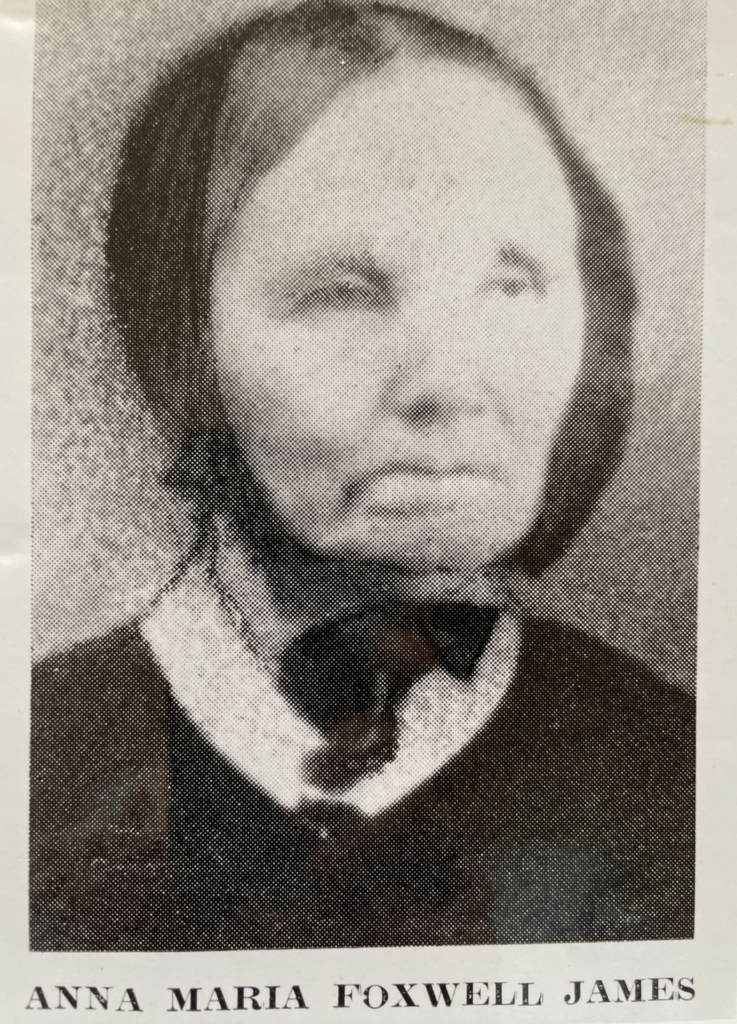
In 1842 the rest of the family William Foxwell, jnr Thomas and Susan Moyle née Foxwell, Anna Maria James née Foxwell and their mother Ann Harris Foxwell left Cornwall to join John, They departed Falmouth on the Orient. Anna Maria was 36 and six months pregnant and travelled with her two youngest sons, aged one and three. Anna Maria’s husband, with the elder two sons, came later as he had not managed to settle his affairs in Cornwall. The voyage took six weeks The ship was not in good condition and the crossing was horrendous. There was a lot of sea sickness. They had to provide their own food, the captain only had to provide his passengers with water. They arrived in New York Harbour then onward by steamer up the Hudson River, barge along the Erie Canal to Buffalo and then wagon to the village of Caledonia.
Let us continue the story of Samuel and Anna Maria James.
They stayed in Wisconsin for seven years. They did not take to the place, disliking the climate and the sickness that frequently assailed them. Samuel was also unhappy with the religious dynamics of the settlement He began to hear about Oregon on the west coast which became part of the territory of America in 1848 and offered new possibilities.. The James’ foresaw that the climate would be more like England. Anna Maria heard that that the area was often muddy – “like Cornwall” she was heard to exclaim.
So a journey of 3000 miles was planned along the Oregon Trail. They left Wisconsin in 1851 with their eight children. They were by this point in their forties. They took three wagons and a number of loose stock. One of the wagons was filled with Samuel’s library of books and astronomical instruments. Like his father in law he was a learned man. The wagon later in the journey went by river freight to Portland. It was a long and gruelling journey lasting four months. They had many encounters with Indian tribes. One cannot underestimate the burden on Anna Maria during their journey. Women were responsible for the provision of meals, care of children, nursing of the sick – and there was much sickness on the Trail. Samuel’s log of the journey makes little mention of such burdens. He could not have embarked on such an endeavour without the whole-hearted support of his wife. Described by her family as ‘remarkably well educated and liberated, she was gay, vivacious, disciplined and a model of cheerfulness’.
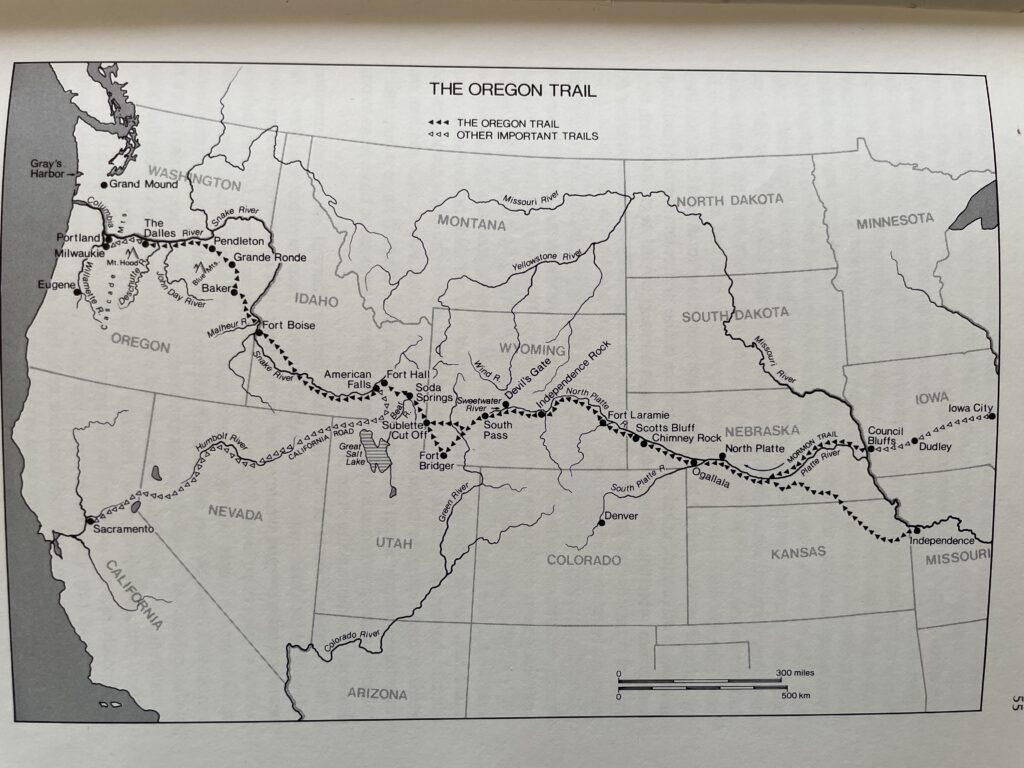
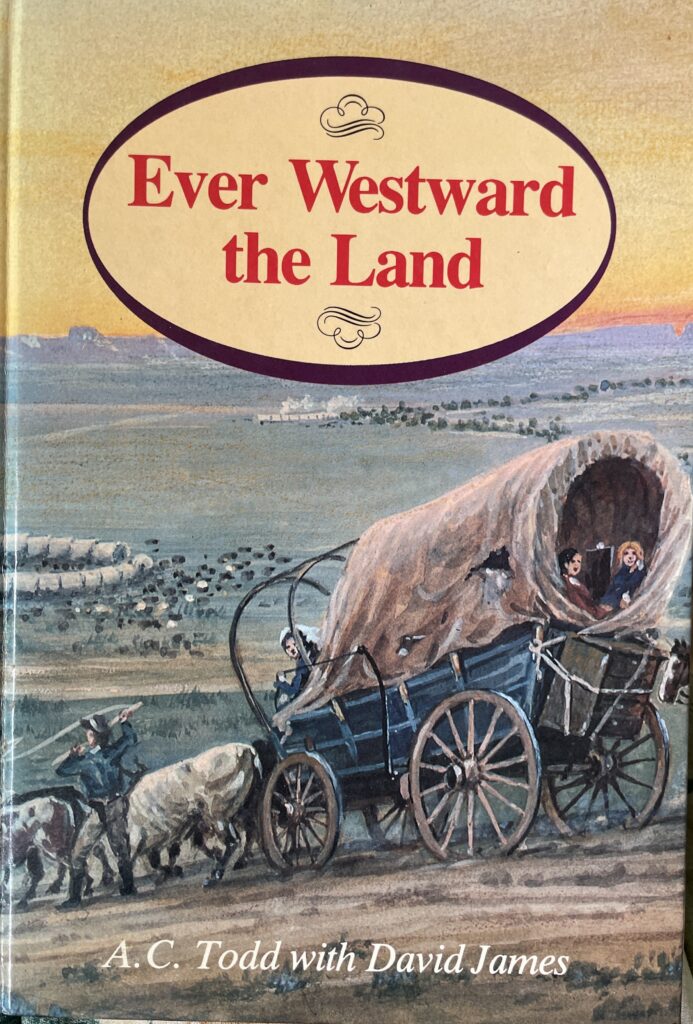
A book written by historian AC Todd along with great grandson David James, telling the story of their journey was published in 1986. I have a copy.
After failing to settle in Portland and Grays Harbour, they finally settled in Grand Mound, Washington State and started to build the settlement subsequently called Jamestown. Their attitude to the indigenous Indians was very much of a piece for the nineteenth century America. A kindly patriarchal attitude, an opportunity to convert them to their brand of Christianity and to teach them the virtue of cleanliness and the use of soap. The Indians taught Samuel skills in adapting to this new land. A complicated story and the book above goes into more detail of the complexities of the white incomers and the indigenous peoples.
I have in my possession the Foxwell jug. There must have been a china service purchased by William and Ann Foxwell in the early 1800s on which the names of family members were painted. This jug has Anna Maria Foxwell on it.
The Foxwells, wherever they settled, embraced their new country and became proud Americans. They celebrated the anniversaries of their coming to America. They rarely returned to England. Contact with family members including their sister Mary Ann, was maintained by letter. Members of the Gartrell family might have visited their American relatives as several of them settled in the USA in the latter part of the nineteenth century. A nephew of Anna Maria, Harry Gartrell made an unexpected visit to Ground Mound in 1859, described in the book (p97). How he made the journey, we do not know. The railroad had not made it to the West Coast at that point. He eventually settled in Australia c1870.
Samuel died in 1864 aged 60.
Anna Maria died in 1879 aged 73.
Later generations developed an interest in their roots in Cornwall which endures to this day. In 1989 when visiting Mullion and happening on a Methodist church fete, I discovered that I had missed a visitation from some of the Foxwell clan by a week!
For a full text of the 1941 centenary pamphlet written by the next generations of the Foxwell family in America go here